
Karnataka joins Tamil Nadu on the path of self-respect. Following Tamil Nadu, Karnataka has rejected the Union Government’s National Education Policy and released its own distinctive State Education Policy. The Karnataka State Education Policy will come into effect from the current academic year.

What does the Karnataka State Education Policy say?
In 2020, the Union Ministry of Education introduced the National Education Policy (NEP), which raised serious questions about the very structure of the country’s education system. The NEP included several regressive measures—such as the three-language formula and the caste-based education approach—that undermined the federal spirit and encroached upon the rights of individual states.
Tamil Nadu Refused to Bow Down!
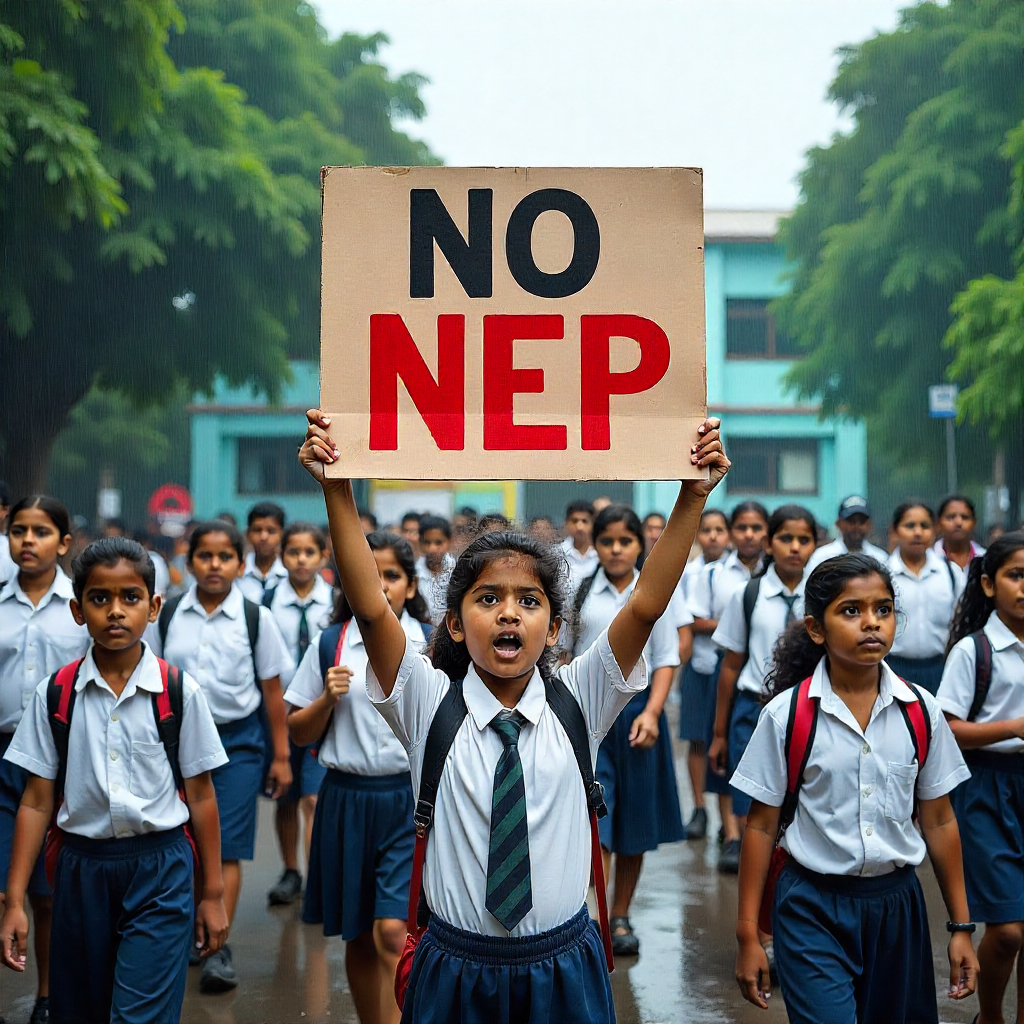
Since education falls under the Concurrent List of the Indian Constitution, the Union Government cannot act unilaterally in this area. In this context, Tamil Nadu refused to accept certain provisions of the National Education Policy (NEP) 2020. Following this stance, on August 8, the Honourable Chief Minister of Tamil Nadu released a State Education Policy specifically designed for school education.
Amidst this backdrop, the State of Karnataka has also released its own State Education Policy just a few days ago, sparking widespread attention and debate.
Karnataka State Education policy Key features
In Karnataka, the BJP-led government had implemented the National Education Policy (NEP) as early as 2020. However, after the Congress government led by Chief Minister Siddaramaiah came to power, it announced that a new State Education Policy would be formulated to ensure quality education. Accordingly, the Karnataka government set up an 11-member State Education Policy Commission headed by eminent educationist and former UGC Chairman Professor Sukhadeo Thorat to draft the policy. This commission submitted the Karnataka State Education Policy (KSEP) on August 11 this year.
An Education Policy that Reflects Culture!
The Karnataka State Education Policy (KSEP) has been designed to strengthen the rights and authority of states in the field of education. Unlike the Union Government’s “One Nation, One Education System” approach under the National Education Policy (NEP), the KSEP is framed based on the social and cultural characteristics of the people of Karnataka. Through this approach, the language, culture, and history of Karnataka have been naturally integrated into the education system.
A Distinct Curriculum & Bilingual Policy
A major reform under the KSEP is the creation of a Comprehensive Curriculum for School Education (CCSE) — a detailed and independent framework designed specifically for the state, replacing the NCERT textbooks used under the national system.
Additionally, the policy mandates the use of the mother tongue/Kannada as the medium of instruction up to Class 5, and adopts a bilingual policy (mother tongue + English). This approach makes learning more accessible and distinctive for students — while resisting the imposition of Hindi, it simultaneously promotes global English proficiency.
A New Education Structure: The 2+8+4 Model
In contrast to the 5+3+3+4 system proposed under the National Education Policy (NEP), the Karnataka State Education Policy (KSEP) introduces a 2+8+4 structure. According to this model: 2 years – Pre-primary education 8 years – Primary education 4 years – Secondary education This structure extends the period of primary education to strengthen foundational literacy and numeracy skills in children. Experts believe this will significantly reduce dropout rates and improve long-term learning outcomes.
Expanding Equity in Higher Education
One of the most notable features of the KSEP is that reservations for SC/ST/OBC students will now apply to private self-financing universities, deemed universities, and autonomous colleges. This measure, grounded in Article 15(5) of the Indian Constitution, ensures that private educational institutions also share the responsibility of upholding social justice.
Additionally, the policy ensures free education for women in government and government-aided colleges, introduces financial incentives to prevent child marriage, and raises the annual family income ceiling for scholarships to ₹10 lakh. These measures reinforce gender equality and social equity in education.
Administrative Reforms and Transparency
To streamline governance, multiple educational bodies will be merged under a single commission. The DSERT will be transformed into SCERT, giving educators direct responsibility for curriculum development. District-level educational administration will also be led by education professionals, ensuring a more academic focus. A State Quality Assessment Board will be established to maintain high standards in teaching and learning. These administrative reforms aim to reduce political interference and empower educators to lead the state’s academic progress.
Teacher Recruitment and Training
The KSEP sets a major goal to fill all vacant teaching posts within the next five years. Recruitment will include KEA-written examinations and university-led interviews, ensuring merit-based selection. New teacher training centers will be established to provide mandatory induction programs for new professors. This dual approach will both improve teaching quality and address teacher shortages effectively.
Research, Innovation, and Financial Support
A State Research Foundation will be established with an initial fund allocation of ₹500 crore to promote state-focused research and innovation. Through the Educational Finance Corporation, low-income students will receive career-oriented education loans, fostering opportunities for upward mobility. Foreign Student Centers will also be set up in all universities to promote internationalization and raise the global standing of Karnataka’s higher education system.
A National Movement in the Making…
The Karnataka State Education Policy is seen as the next phase in the movement for states’ educational rights, standing in contrast to the centralized NEP. By following in the footsteps of Tamil Nadu’s self-respect-based education model, Karnataka’s independent policy signals the emergence of a national trend — where each state may develop its own education policy that reflects regional identity, culture, and autonomy. As educationists observe, this could well evolve into a nationwide movement for educational federalism and diversity in the coming years.
Also Read :
- Guiding College Field Trip - 2025
- Expansion of the Chief Minister’s Breakfast Scheme! Let the stomach be full; let the ears open!

Follow us
Whatsapp Channel – bit.ly/anbilmahesh4evr
X ID – https://x.com/AnbilMahesh4evr
Youtube – https://youtube.com/@AnbilMahesh4evr
Facebook – https://fb.com/AnbilMahesh4evr
Instagram – https://instagram.com/AnbilMahesh4evr